

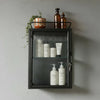
If it's worth keeping, isn't it worth seeing?
, by Sarah Frame, 2 min reading time
, by Sarah Frame, 2 min reading time
There is a difference between storing something and hiding it.
Most storage is hiding. A drawer closes. A cupboard door shuts. Whatever was on the surface disappears, and the room breathes a small sigh of relief. Tidiness achieved. Things unseen. Problem solved.
Except it isn't, quite. Because the things you hid are still there. You just can't see them. And somewhere in the back of your mind, neither can you.
Display is a different idea entirely.
Display says: I chose this. This bottle, this book, this small collection of things I reach for every day. I chose them carefully enough to put them somewhere visible. Behind glass if you like, softened by the texture of it, caught by the light through it. Not hidden. Considered.
A wall cabinet with ribbed glass does something that a drawer cannot. It frames what's inside. The glass blurs the detail slightly, softens the edges, turns a shelf of everyday objects into something that looks, from a distance, deliberate. Intentional. Edited.
Editing is the point.
When you know that what you put inside will be visible, you choose more carefully. The ugly plastic bottle leaves. The beautiful ceramic one stays. You are not decorating. You are deciding what deserves to be seen. That decision, made quietly and repeated over time, changes the way a room feels. It changes the way you feel in it.
The wall matters too. Eye level. The place you look when you are standing in a room thinking about nothing in particular. That is where these cabinets live. That is where the things inside them are seen every day, not buried, not forgotten, not waiting behind a door that only opens when something is needed.
Walls have been ignored for too long in the storage conversation. We put things on floors, in cupboards, under beds. We treat storage as something to be solved and then concealed. The wall cabinet refuses that logic. It says storage can be part of the room, not hidden from it. It says the things you keep every day are worth looking at.
Not everything needs to be on display. That would be its own kind of chaos. But the things that are, the bottles and books and small beautiful objects that make up the texture of a life, deserve better than a drawer.
They deserve a frame.
Put them on the wall. Behind glass. Where the light can find them and you can see them every day.
If it is worth keeping, it is worth seeing.
That is Life on Display.